
Less than a year before an uphill election President William Ruto thought he could win support by banning foreign traders but all it bought him was a diplomatic spat, mass protests and the targeting of Burundian street hawkers
On a pavement in Nairobi, a Burundian woman sells peanuts by the cup. Suddenly, her stock is confiscated by youths invoking the name of President William Ruto, who had declared that foreign nationals would be shut out of small-scale retail and informal trade.
A few kilometres away, at State House, the President’s hasty declaration is already being rewritten by officials desperate to prevent it from becoming a full-blown diplomatic incident.
This is how a campaign-trail line — delivered to aggrieved traders eleven months before a general election — spiralled into an East African dispute, and how the government spent 48 hours trying to contain it.
It started when Nairobi retailers staged a protest over the tax burden on imported goods, directing their anger at Chinese-owned outlets whom they accused of unfair competition. The demonstration ended at State House, where President Ruto met traders and their leaders.
What emerged was a declaration: foreign nationals would be shut out of small-scale retail and informal trade, loosely tied to the Local Content Bill, 2025, currently before Parliament. No bill was tabled. No policy paper was released.
The move follows a pattern. Weeks earlier, the President ordered Tata Chemicals off its long-held mining concession at Lake Magadi, on Maasai community land in Kajiado, over claims the contract had been exploitative. Both decisions share the same signature: politically popular in the moment, legally improvised, and announced before an enforcement framework exists.
The declaration did not stay rhetoric for long. Within days, groups of Kenyan youth began harassing, beating, and robbing foreign small traders — predominantly Burundian nationals hawking tea, peanuts, and shoes in Nairobi.
The diplomatic fallout was immediate. Burundi’s Foreign Minister lodged a formal protest and petitioned East African Community Chairman President Yoweri Museveni to convene an emergency meeting of member states. As of this briefing, that meeting has yet to be scheduled.
International coverage amplified the damage. Le Monde framed the episode as a blanket ban on foreign traders, a characterisation Nairobi could not afford to let stand.
What followed was crisis management in two acts, delivered a day apart.
The Office of the Government Spokesperson issued the first, softer correction. The directive was not about expulsion, it said, but about documentation. It announced a Documentation and Registration Window, urging undocumented East African nationals — Burundians in particular — to report to their High Commissions and embassies. During the window, those who register would be presumed legally present. The Ministry of Foreign Affairs, it added, was in direct contact with Burundi’s embassy. It also issued a warning: the government would not tolerate vigilante enforcement.
State House Spokesperson Hussein Mohamed delivered the second, more substantive correction. The President, he announced, had directed that the Local Content Bill, 2025 be expanded to define which trades are reserved for Kenyans and which remain open to foreign nationals who are lawfully present. A 90-day regularisation window was set, running to early December 2026, during which agencies would assist traders to regularise permits, registration, and licences before strict enforcement begins. Crucially, it clarified that enforcement authority rests exclusively with the state — citizens and vigilante groups have no role, and grievance is no licence for violence.
Two statements, two audiences, one objective: contain the diplomatic damage first, then retrofit the roadside declaration into due process without renouncing the underlying promise to reserve trade for Kenyans.
The timing is inseparable from the 2027 electoral arithmetic.
In July 2024, in the aftermath of the deadly Gen Z protests against the Finance Bill, Ruto and opposition leader Raila Odinga formed what was called a “broad-based government” — Odinga’s Orange Democratic Movement (ODM) MPs and allies were brought into the cabinet, though Odinga himself did not take a cabinet post.
The death of Odinga on October 15 last year cost Ruto the coalition partner through whom he had inherited Western Kenya, Nyanza, the Coast, and Nairobi under the broad-based government pact. That inheritance is now contested.
Edwin Sifuna, 44, the Kakamega-born Nairobi senator ousted from the ODM secretary-general’s post in mid-2026 amid the party’s internal rift over the Ruto pact, now leads a breakaway faction that has pulled Western Kenya, Nyanza, Nairobi, and the Gen Z vote out of the President’s column. Mount Kenya has consolidated behind impeached former Deputy President Rigathi Gachagua. Eastern Kenya aligns with veteran Kalonzo Musyoka. All three factions are reported to be aligning behind a single unity candidate for August 2027.
Squeezed on multiple fronts with no uncontested bloc, the President is trying to manufacture tangible wins where he can — at trader rallies, in land disputes, through roadside declarations that earn evening-news applause even before they acquire legal footing.
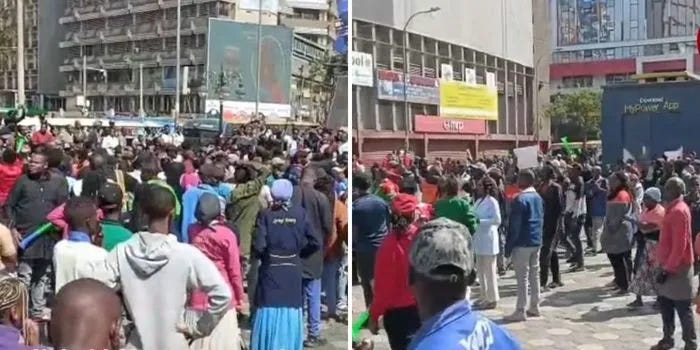
What was striking, however, was the number of young Kenyans who took to the streets to protest against Ruto’s declaration and defend their fellow East African citizens. This stood in stark contrast to the xenophobic violence that erupted in South Africa starting in April 2026, which was far more extensive in terms of the number of foreign nationals attacked and driven from the country, and where protests in response were far fewer.
While some Kenyans were bemused by the President’s fancy footwork, his government’s swift about-turn also contrasted with the clumsy, defensive response of South African authorities to the anger and concern expressed by other African countries over the treatment of their nationals.
Whether that quick about-turn survives contact with the Local Content Bill’s 90-day clock or whether, come December, another peanut vendor loses her stock to a promise still waiting on a policy is the question Nairobi has bought itself time to avoid.
It backfired for Ruto. He should be ashamed of himself to try and bring divisions among who have peacefully lived together for years